
Volleyball Shoulders — Beach vs. Indoor in San Diego
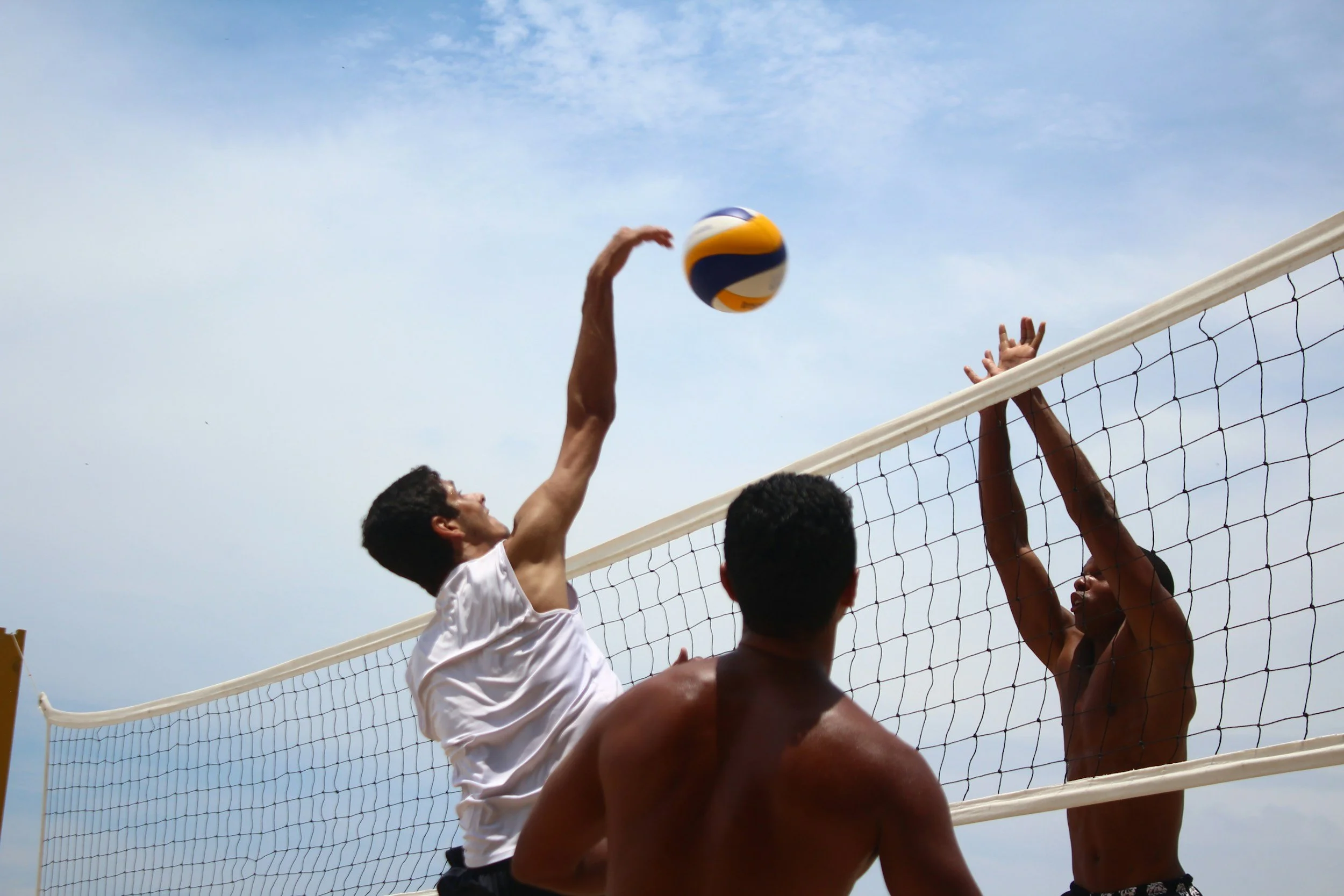
Beach volleyball at the net
Written and clinically reviewed by Dr. Ashley Aguero, DC — August 13, 2026
San Diego might be the only place in the country where an athlete can play indoor on a Tuesday night, beach doubles on Saturday morning, and never really have an off-season. A lot of the players I see do exactly that.
So when a volleyball player comes in with a shoulder that’s started talking, the first thing I want to know isn’t where it hurts. It’s which version of the sport they’ve been playing, and how much. Beach and indoor share a name, a ball, and a net. They don’t share a workload.
The Short Answer
Volleyball shoulder pain is often associated with repetitive overhead workload rather than one obvious injury, and that workload can look different depending on which version you play. Indoor volleyball can concentrate repeated high-velocity swings on the dominant side, while beach volleyball changes the volume and variability of contacts. One important demand isn’t just accelerating the arm—it’s controlling and decelerating it after contact, which repeatedly loads the rotator cuff and surrounding shoulder musculature.
Why Are Beach and Indoor Volleyball So Different for the Shoulder?
Indoor volleyball is six players, a hard floor, a fast ball, and specialised roles. If you’re an outside hitter, you hit. Rallies are short and explosive, and a hitter can accumulate a high number of near-maximal swings across a practice or match, plus blocking reps at the net — all on a surface that gives nothing back on landing.
Beach volleyball is two players, sand, wind, and no specialisation at all. Every ball that comes over is yours or your partner’s, which means roughly half of everything. You serve, you pass, you set, you hit — often in the same rally. Rallies run longer, tournament days run much longer, and the sand absorbs your landing while demanding far more to produce the jump.
Different demands. Same shoulder.
What the Hitting Shoulder Is Actually Doing
The volleyball swing is one of the faster movements in sport, and three structures do most of the work of producing it and surviving it:
— The rotator cuff — four muscles that contribute to shoulder stability, help control the humeral head during high-speed movement, and are involved in decelerating the arm after contact.
— The scapula (shoulder blade) — which has to rotate upward and tilt to give the arm a stable base and clear space to move overhead.
— The thoracic spine (your mid-back) — which contributes extension and rotation to the overhead position. The thoracic spine contributes to positioning during overhead movement, and available thoracic motion may influence how an athlete achieves their hitting position.
When swing, serve, and block volume exceeds what the shoulder is currently prepared to tolerate, factors such as rotator cuff endurance, scapular control, thoracic mobility, training history, and recovery may all influence whether symptoms develop.
Indoor Volleyball: Velocity, Repetition, and a Floor That Gives Nothing Back
The indoor pattern is usually a volume-and-velocity story. Hitters take near-maximal swings in practice and again in matches, blocking adds repeated overhead reaching at the net, and the floor means every landing is absorbed by the athlete rather than the surface.
Indoor also concentrates the workload — an outside hitter may swing on nearly every rally for two hours and do little else. Years of largely one-sided overhead work can be associated with adaptations in shoulder rotation and scapular position on the dominant side. Some of that is normal adaptation; some may be worth addressing.
The indoor athletes I see locally are mostly rec-league and club players stacking two or three nights a week on top of a full training schedule. That’s a real workload, and it rarely gets counted as one.
Beach Volleyball: Fewer Players, More Contacts, Unstable Ground
Beach flips several of those variables. Sand changes landing mechanics and typically reduces impact forces compared with a rigid indoor surface, while also changing the muscular demands required to jump and move. And with two players instead of six, each athlete’s contact count per match climbs substantially.
Then there’s the environment. Wind and glare on a Mission Beach afternoon turn a clean, repeatable swing into a variable one — you reach further, you swing slightly off balance, contact moves each time. Repetition with variability is a different demand than repetition with consistency.
If you play the permanent nets at South Mission Beach, the courts at Ocean Beach, or Mariner’s Point at Mission Bay, you already know how quickly a casual session turns into three hours. And a CBVA or San Diego Beach Volleyball League tournament day is several matches in the sand in one afternoon — which is a workload spike, however fun it is. Spikes in workload are one of the more common things I end up asking about.
What Patterns Show Up in San Diego Volleyball Players?
— Discomfort at the top of the cocked position. Limited thoracic mobility or changes in scapular mechanics may contribute here, though symptoms at end range can have several potential causes.
— Fine indoors, sore after beach — or the reverse. Usually a clue that one format is asking for something the athlete hasn’t been regularly exposed to.
— The off-season that never happened. San Diego’s climate makes year-round play possible, which can mean some athletes move from season to season without a meaningful reduction in volleyball volume.
None of these are diagnoses. They’re patterns. Which one you’re dealing with — if any — is exactly what an assessment is for.
What Actually Helps Volleyball Shoulder Pain?
It depends on the athlete, but the approach usually combines a few things:
— Addressing thoracic mobility when limited. For some athletes, improving available mid-back motion may support a more efficient overhead position.
— Soft tissue work. Manual therapy. Techniques such as soft tissue therapy, cupping, or IASTM may be incorporated when appropriate to help manage symptoms or short-term mobility limitations as part of a broader treatment and rehabilitation plan.
— Adjustments where indicated. Joint manipulation or mobilization may be incorporated as part of a broader plan based on exam findings.
— Targeted rehab. Progressive strengthening and endurance work for the rotator cuff and scapular musculature can be used to build capacity for the repeated overhead demands of volleyball.
— A workload conversation. For athletes playing both formats, mapping where the swings are actually coming from is often as useful as anything I do by hand. For players who also lift, see shoulder pain when lifting.
Should You Play Through Volleyball Shoulder Pain, or Stop?
The honest answer is that it depends on what the pain is doing.
A mild, stable ache that doesn’t worsen during play and settles back to baseline afterward may sometimes be managed with load modification, depending on the individual and what an assessment finds. Pain that sharpens through the cocked position, that’s worse match over match, or that comes with weakness, loss of range, or a change in how hard you can hit is a signal to back off and get it looked at.
What I’d steer you away from is ignoring a changing or progressively worsening shoulder for an entire season. Earlier assessment can help clarify what you’re dealing with and whether your training needs to be modified.
How Can You Support Shoulder Capacity Between Seasons?
Even without symptoms, a few habits may help. Warm up the shoulders and mid-back before you play, rather than using your first ten serves as the warm-up. Keep some rotator cuff and scapular endurance work going in-season, not just preseason. And be deliberate about the transition — going straight from an indoor season into a full beach tournament schedule is a real change in workload, even though it’s still volleyball.
Frequently Asked Questions
Do I need a sports chiropractor for volleyball shoulder pain, or a regular chiropractor?
Both are Doctors of Chiropractic. At ELATE, the assessment also considers the demands of your sport—such as swing and serving volume, beach versus indoor play, training schedule, shoulder function, and the movements that reproduce your symptoms. For athletes whose symptoms are connected to training or competition, that context can be useful when building an individualized plan.
Is beach volleyball harder on your shoulder than indoor?
Not harder — different. Beach raises your total contacts per match because there are only two of you, and wind makes each swing slightly different. Indoor concentrates near-maximal swings on one side and adds hard-floor landings. Which one bothers a given shoulder depends on the athlete.
How long does volleyball shoulder pain take to settle?
It depends on what’s driving it, how long it’s been going on, and whether playing volume changes. That’s why the first visit includes an assessment rather than a timeline — an honest estimate needs findings behind it.
Can I keep playing while I get treatment?
Often yes, with modified volume. Pain that stays mild and stable and settles afterward may sometimes be managed with modified volume, depending on the athlete and the underlying presentation. Pain that sharpens through the cocked position, worsens match over match, or comes with weakness or lost range is a reason to get it assessed before continuing.
Do you see volleyball players from the beach communities?
Yes. The clinic is in North Park, which is roughly fifteen minutes from the Mission Beach and Ocean Beach courts, and we see players from beach leagues, CBVA tournaments, and indoor rec and club leagues across San Diego.
A Note on What This Article Is Not
This isn’t a diagnosis for your specific shoulder, and sports chiropractic isn’t a replacement for medical evaluation. Certain presentations — including significant trauma, substantial weakness or loss of function, persistent night pain, or findings that raise concern for structural injury — may warrant additional medical evaluation, imaging, or referral to an appropriate specialist.
How to Get Started at ELATE
ELATE Chiropractic & Sports Medicine is a cash-based sports chiropractic practice in North Park, San Diego, serving athletes, lifters, surfers, and active adults across the city — including players coming from the beach courts at Mission Beach, Ocean Beach, and Pacific Beach. We accept HSA and FSA payments and can provide a superbill for potential insurance reimbursement.
A first visit is the 60-minute initial appointment ($195), where I evaluate your symptoms, movement, strength, range of motion, and the demands of your sport before discussing an individualized plan. If you’re not sure whether your shoulder needs hands-on care or a smarter in-season plan, the contact form is the easiest way to ask.
Book an Initial Appointment → · Explore Our Services →
Dr. Ashley Aguero, DC, is a Doctor of Chiropractic with a Sports Medicine emphasis. She holds a B.S. in Kinesiology from CSU San Marcos and a Doctorate of Chiropractic from Southern California University of Health Sciences. A San Diego native and CrossFit athlete, she has sideline experience in high school football, rugby, and cycling.
